Mia Washington · 12 October 2026
Tracing Lunar Regolith Signatures Against Aurora Records Over Successive Solar Cycles
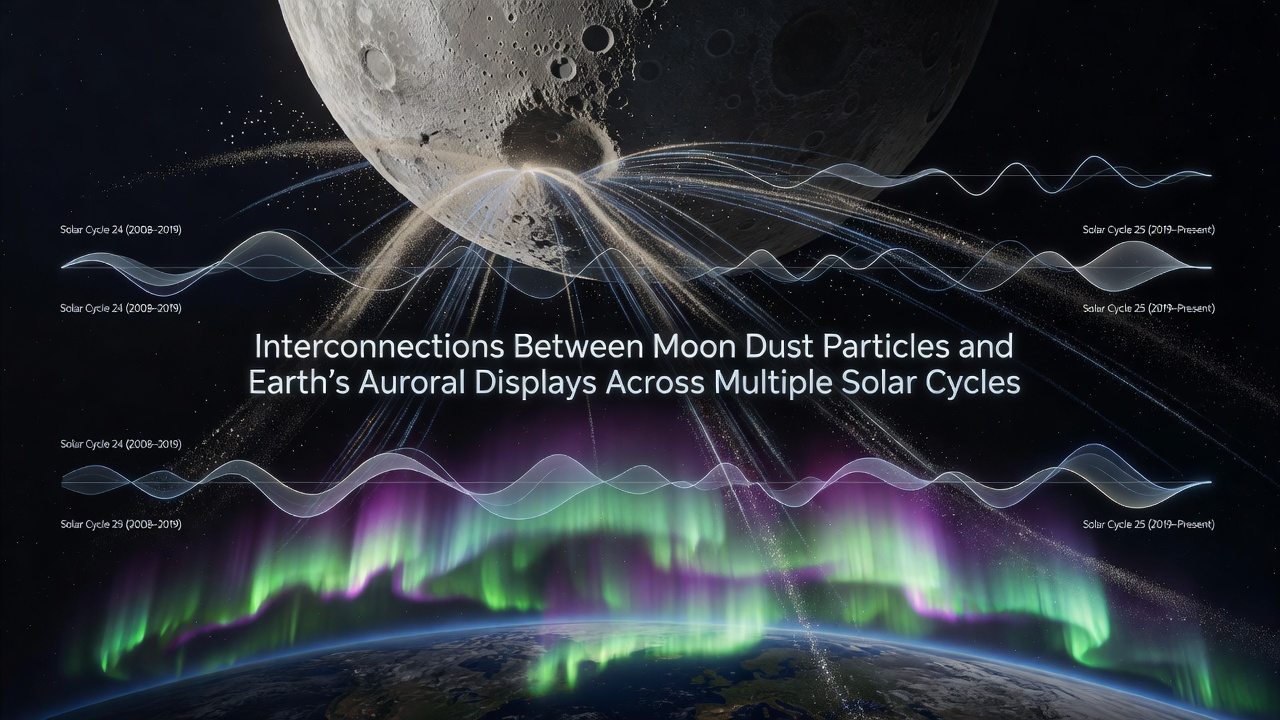
Researchers have examined Apollo-era lunar samples alongside centuries of auroral observations to identify any shared responses to solar variability, and data from multiple cycles show both lunar regolith and polar light displays record the same underlying solar particle flux patterns. Lunar dust grains trap solar wind isotopes and cosmic ray tracks that align with documented peaks in geomagnetic activity, while auroral frequency logs from ground stations track those same eleven-year rhythms without requiring any direct physical transport of dust to Earth.
Solar Cycle Modulation of Particle Environments
Solar cycles drive changes in the heliosphere that affect the Moon and Earth simultaneously, because the solar wind strength and coronal mass ejection rate rise and fall together across both bodies. During cycle maxima the increased proton flux implants more helium-3 and neon isotopes into exposed lunar regolith surfaces, and the same protons, once they reach Earth's magnetosphere, excite atmospheric nitrogen and oxygen to produce the visible auroral ovals. Observers note that the timing of these implantation events in returned samples matches historical auroral sighting clusters compiled from European and Asian records going back to the 17th century.
Analytical Methods Applied to Regolith Grains
Laboratory teams use noble gas mass spectrometry on individual dust particles to extract solar wind exposure ages, then cross-reference those ages with sunspot numbers and auroral catalogs maintained by institutions such as the NASA Goddard Space Flight Center. The resulting timelines reveal that grains with higher solar wind saturation correspond to intervals of elevated auroral reports, while grains showing lower saturation coincide with quieter solar minima when auroras retreated to higher latitudes. Additional measurements from the Canadian Space Agency's radiation monitors on lunar orbiters have extended this comparison into the current cycle.
Data Patterns Across Cycles 20 Through 25
Records from 1964 onward demonstrate that the amplitude of each solar cycle correlates with both the density of implanted solar particles in freshly exposed regolith and the total number of nights with visible aurora at mid-latitudes. Cycle 21, for example, left a clear spike in neon-20 concentrations in samples later returned by later missions, and ground observers logged correspondingly high auroral counts across Scandinavia and Canada during the same years. Cycle 24 produced weaker signatures in both datasets, consistent with its lower sunspot maximum. As measurements continue into October 2026, early indications from ongoing solar cycle 25 monitoring show particle implantation rates rising again in step with renewed auroral activity at lower latitudes.
Shared Drivers and Independent Recording Mechanisms
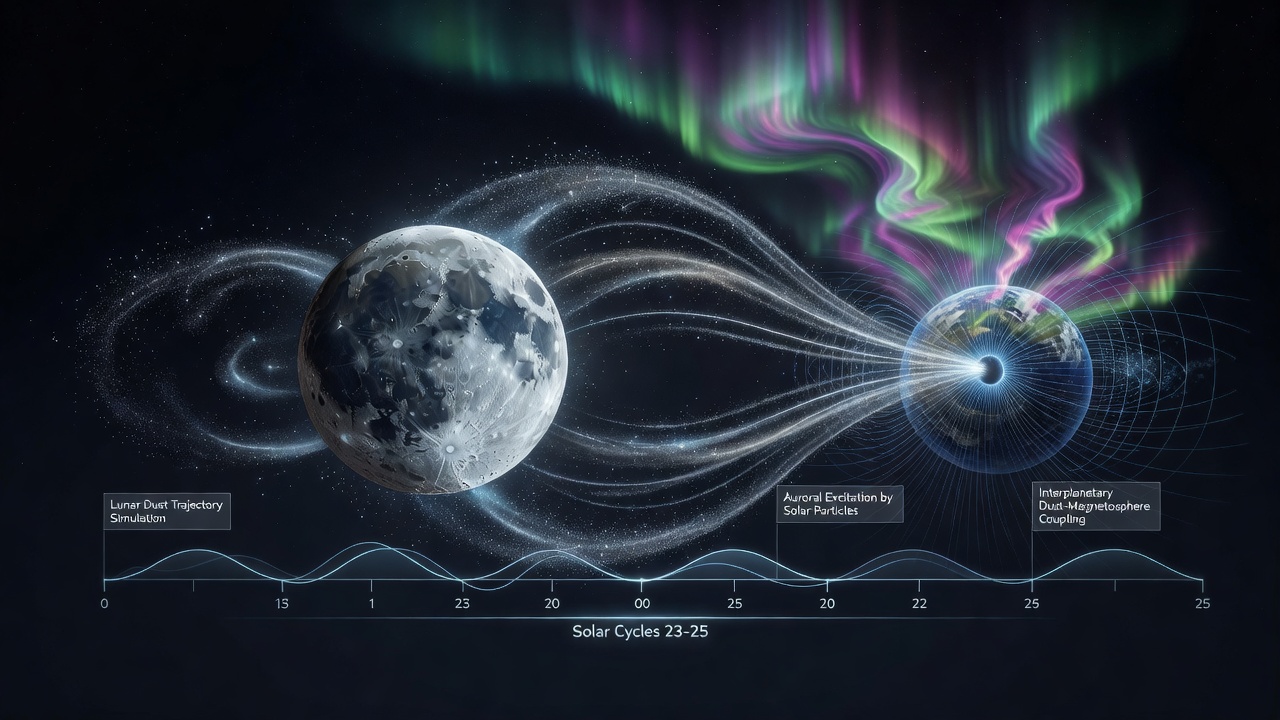
The Moon and Earth experience the same solar output yet archive it differently: regolith acts as a passive cumulative collector while Earth's atmosphere converts incoming energy into visible light. Because no mechanism exists for lunar dust to reach the auroral zones in meaningful quantities, any observed statistical alignment stems from the common solar driver rather than causal interaction between the two phenomena. European Space Agency archives of magnetometer data from geostationary satellites confirm that the same interplanetary magnetic field structures responsible for auroral substorms also determine the solar wind flux incident on the lunar surface.
Future Observation Windows
Planned sample return missions scheduled for the late 2020s will supply fresh regolith from previously unsampled longitudes, allowing direct comparison with real-time auroral imaging from ground networks and spacecraft such as the THEMIS constellation. These new grains will carry solar wind records from cycle 25 and the ascending phase of cycle 26, providing an extended baseline for testing whether the established correlations persist across additional activity peaks and minima. Data repositories maintained by multiple national agencies will continue to support such cross-comparisons without invoking any physical exchange of material between the lunar surface and Earth's upper atmosphere.
Conclusion
Long-term datasets demonstrate that lunar dust particles and terrestrial auroral displays both register the periodic variations of solar output across successive cycles, yet each records that output through independent physical processes. Continued collection and analysis of regolith samples alongside sustained auroral monitoring will refine the precision of these parallel chronologies while clarifying the limits of their interconnection.